Stop Writing Fluff: How to Make Every Sentence in Your Essay Earn Its Place
You sit down to write an essay, and you hit the word count. Barely. But as you reread your work, something feels off. Sentences stretch on forever. You keep saying the same thing in different ways. Your professor’s feedback says “vague” or “needs more substance.” This is the curse of fluff. It pads your page count without adding value. It makes you sound like you are running in place. And it hurts your grades more than you think.
Fluff is any word, phrase, or sentence that does not move your argument forward or clarify your point. To avoid it, you need to identify filler phrases, cut redundancies, replace weak verbs with strong ones, and use specific examples instead of general statements. This guide gives you a repeatable editing system to make every sentence earn its place.
What Fluff Actually Looks Like
Fluff hides in plain sight. It is the extra words we add because we think they sound more academic or because we are trying to stretch a thin idea to fill a page. Here are the most common types:
- Redundant phrases: “Advance planning,” “end result,” “past history.” These pairs say the same thing twice.
- Weak intensifiers: “Very,” “really,” “quite,” “extremely.” These words add emotion but not meaning.
- Wordy transitions: “Due to the fact that” instead of “because.” “In the event that” instead of “if.”
- Empty openers: “It is important to note that,” “There is no doubt that,” “It should be said that.”
- Repeated arguments: Restating the same claim in three different sentences within one paragraph.
If you remove a phrase and the sentence still makes sense, that phrase is fluff.
The One-Question Test for Every Sentence
Before you finalize any draft, run each sentence through this filter:
Does this sentence add a new idea, a specific detail, or a necessary connection? If the answer is no, delete it.
Think of your essay like a backpack for a hike. You only bring what you need. A second pair of boots? No. A water bottle? Yes. Extra snacks for energy? Yes. A decorative throw pillow? Absolutely not. Every sentence should carry weight. If it is just taking up space, it slows down your reader.
A Practical Editing Process to Cut Fluff
Follow these steps after you finish your first draft. Do not try to edit while you write. Separate the two tasks.
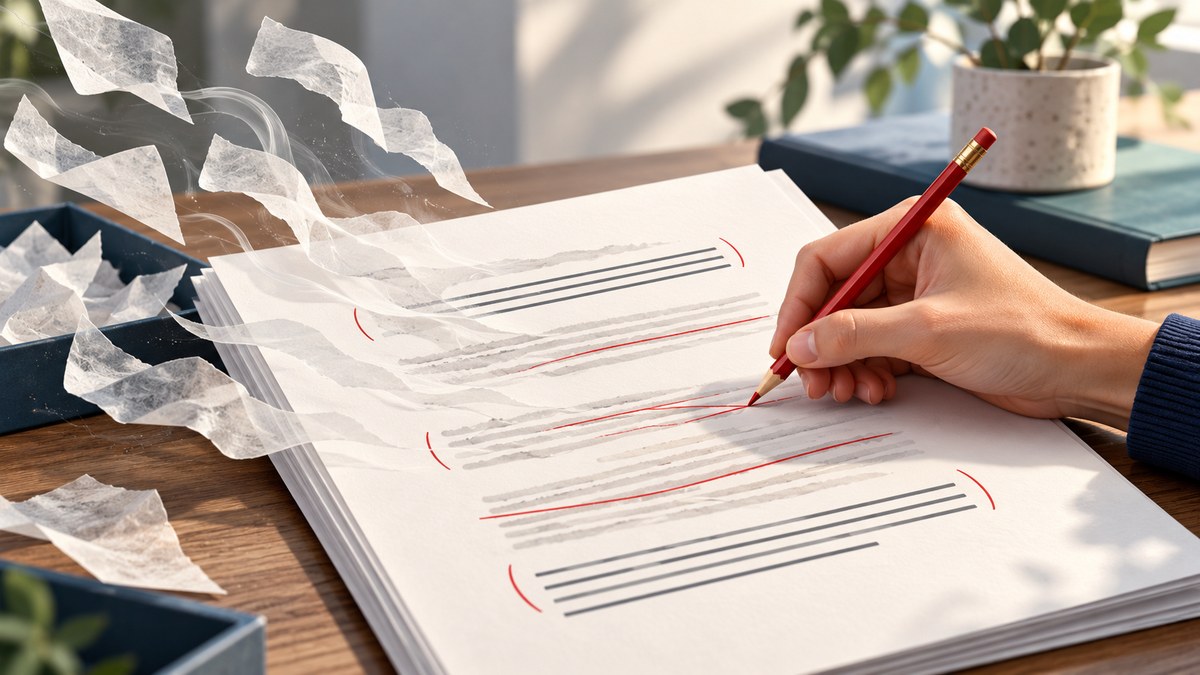
- Read your essay out loud. Your ear catches awkward phrasing and repetition faster than your eyes. If you stumble over a sentence, it probably needs trimming.
- Highlight every sentence that starts with “There is” or “It is.” Rewrite them to start with the actual subject. Change “It is important for students to study regularly” to “Students who study regularly earn higher grades.”
- Circle every “very,” “really,” “quite,” and “extremely.” Delete them. See if the sentence loses meaning. Most of the time, it does not.
- Look for pairs of sentences that say the same thing. Keep the stronger one. Delete the weaker one.
- Replace weak verbs with strong ones. Change “She made a decision” to “She decided.” Change “He gave assistance” to “He helped.”
- Cut prepositional phrases where possible. “The opinion of the committee” becomes “The committee’s opinion.” “In the field of education” becomes “In education.”
After you apply these steps, you will often cut 15 to 25 percent of your word count without losing a single idea.
Common Fluff Mistakes and How to Fix Them
The table below shows typical fluff patterns and their leaner alternatives.
| Fluffy Phrase | Lean Replacement | Why It Works |
|---|---|---|
| Due to the fact that | Because | One word replaces five. |
| In order to | To | Removes unnecessary preposition. |
| At this point in time | Now | Avoids wordy time references. |
| The reason why is that | Because | Cuts the roundabout explanation. |
| In the event that | If | Standard conditional word is clearer. |
| Has the ability to | Can | One word replaces four. |
| Is able to | Can | Same fix as above. |
| In the process of | While | Shorter and more direct. |
| A majority of | Most | Fewer syllables, same meaning. |
| In spite of the fact that | Although | Removes the verbal clutter. |
When Details Become Fluff
Some writers swing too far in the opposite direction. They add details that do not serve the argument. A description of the weather in a history essay about the Cold War is fluff unless the weather directly affected a specific event. A personal anecdote about your summer job is fluff unless it ties directly to your thesis.
Ask yourself: “Does this detail help prove my point?” If the answer is no, it is fluff. If the answer is maybe, it is probably still fluff. Save those details for a journal entry or a creative piece.
For a deeper look at building arguments that hold weight without extra words, check out our guide on how to build a persuasive argument in your essay. It pairs well with the editing techniques above.
The Power of Specific Examples
The best way to replace fluff is with concrete evidence. Instead of writing “Many studies show that exercise improves mood,” write “A 2023 study from the University of Vermont found that 30 minutes of moderate exercise reduced anxiety scores by 26 percent.” The second sentence is longer, but every word earns its place. It gives a source, a number, and a specific outcome.
Specific examples do the work that vague statements cannot. They prove your point. They make your writing credible. They also naturally increase your word count without adding filler. If you need to lengthen an essay, add a second example or a counterexample. Do not add a fourth sentence restating your first example.
If you want more strategies for adding substance without padding, read our article on how to elevate your essay with powerful evidence and examples. It shows you how to find and integrate strong support for every claim.
Why Professors Spot Fluff Instantly
Professors read hundreds of essays per semester. They have developed a sixth sense for fluff. When they see a sentence like “In today’s modern society, it is widely believed that education plays a very important role in the lives of students,” they know you are stalling. They have read that exact sentence fifty times before. It tells them you did not have a clear point to make.
Professors reward clarity. They reward confidence. When you write “Education shapes career outcomes” instead of the padded version, you sound like someone who knows what they are talking about. You also respect their time. That respect often shows up in your grade.
A Writer’s Mindset Shift
The hardest part of cutting fluff is not the editing. It is the mindset. Many writers believe that longer equals better. They think a short paragraph looks lazy. They worry that a professor will see a three-page essay and assume they did not try.
The opposite is true. A concise essay that says everything it needs to say in three pages is harder to write than a five-page essay full of repetition. Every word in that three-page essay was chosen deliberately. That takes skill. Professors notice skill.
Start thinking of your first draft as a lump of clay. Your job is to carve away everything that does not belong. The final shape should be clean and purposeful. You are not adding fluff to make the clay bigger. You are removing excess to reveal the sculpture inside.
For a complete system that takes you from planning to final polish, try the 7-step framework for writing A+ essays every time. It includes a built-in editing phase that catches fluff before you submit.
How to Build a Fluff-Free Writing Habit
You will not break the fluff habit overnight. But you can build a repeatable process that gets easier each time.
- Keep a list of your personal filler words. Everyone has them. Maybe you overuse “however” or “therefore” or “importantly.” Write them down and search for them during editing.
- Set a word budget for each paragraph. Before you write, decide what each paragraph needs to accomplish. If a paragraph runs long, force yourself to cut it back to the essentials.
- Use a readability tool. Many writing apps show you sentence length and passive voice. Use them as guides, not rules.
- Practice rewriting bad sentences. Take a fluffy sentence from a past essay and rewrite it three different ways. Compare which version is clearest.
If you struggle with structure that leads to fluff, review how to structure an essay that captivates your reader from the first sentence. A strong structure leaves less room for wandering.
The Real Cost of Fluff
Fluff does more than bore your reader. It buries your best ideas. When you surround a strong argument with weak sentences, the argument loses its impact. Your reader has to dig through layers of filler to find what matters. Most readers will not bother. They will skim. They will miss your best points.
Your job as a writer is to make your ideas impossible to miss. That means removing anything that gets in the way. Fluff is noise. Your argument is the signal. Make the signal loud and clear.
Turn Lean Writing into a Superpower
Learning how to avoid fluff in writing is not just about fixing one essay. It is a skill that carries into every email, report, cover letter, and application you will ever write. Hiring managers read hundreds of resumes. Scholarship committees read hundreds of personal statements. They all want the same thing: clear, direct, confident writing that respects their time.
When you master the ability to say exactly what you mean in the fewest possible words, you stand out. You sound professional. You sound prepared. You sound like someone who knows what they are saying.
Start with your next assignment. Write your first draft freely. Then apply the editing process from this guide. Cut the fluff. Strengthen the verbs. Add specific examples. Read it out loud. Submit something that makes every word count.
Your ideas deserve to be heard. Do not let filler drown them out.